Best Portable Air Conditioners for Small Rooms
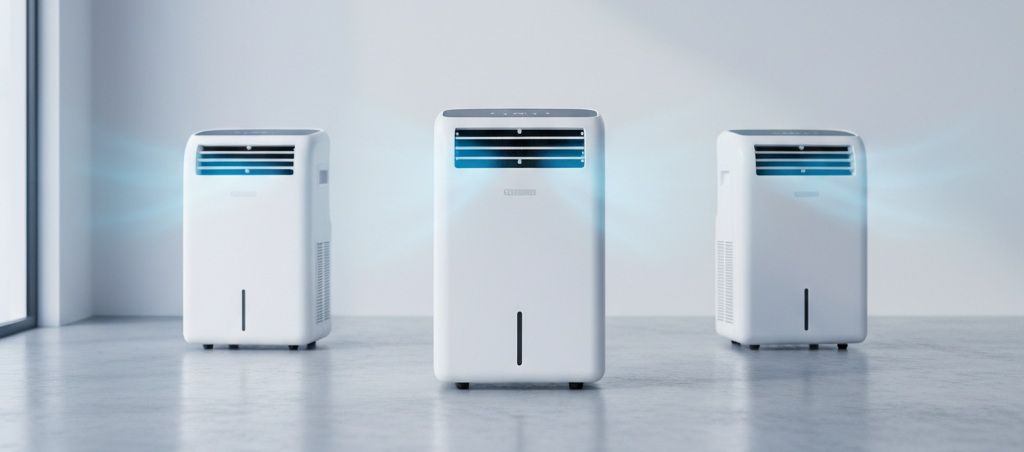
That "12,000 BTU" label on the box is almost certainly misleading. Manufacturers routinely use the outdated ASHRAE standard, which can overstate real-world cooling power by up to 30% compared to the newer DOE/SACC rating. This guide cuts through that marketing noise, explains which specs actually matter for small rooms, and recommends five portable ACs across every budget — so you can finally sleep cool.
🏠 Moving or Redecorating? Create a Registry!
Get everything you need for your new space. Create a FREE home registry and enjoy easy gifting, group contributions, and exclusive completion discounts.
Create Your Home Registry →✓ Universal registry ✓ Easy returns ✓ Group gifting
Our Top 5 Picks: Best Portable Air Conditioners for Small Rooms in 2026
BLACK+DECKER BPACT08WT Portable Air Conditioner

A single-hose 3-in-1 portable unit that cools, dehumidifies, and fans rooms up to 400 sq. ft. without permanent installation.
Pros:
- Compact 15.3" × 14" × 24.8" footprint with bottom casters and dual side handles for easy room-to-room mobility
- "Follow Me" remote doubles as a roaming thermostat, sensing temperature at your location rather than just at the unit
Cons:
- The 8,000 BTU headline rating drops to just 3,950 BTU SACC—real-world cooling power is considerably lower than advertised
- Single-hose design pulls indoor air for exhaust, reducing efficiency compared to dual-hose alternatives
Best For: Renters or apartment dwellers who need a no-install cooling option for a single bedroom or small living area.
Quick Comparison Table
| Product | Price | Rating | Reviews |
|---|---|---|---|
| BLACK+DECKER Portable Air Conditioner, 8... | $299.99 (29% off) | 4.1/5.0 ⭐ | 16,020 |
| Portable Air Conditioners, 10,000 BTU Po... | $299.99 (25% off) | 4.6/5.0 ⭐ | 163 |
| DREO Portable Air Conditioner 318S, 8000... | $389.99 (11% off) | 4.4/5.0 ⭐ | 498 |
| Portable Air Conditioner, 14000 BTU Fast... | $399.99 (33% off) | 4.8/5.0 ⭐ | 107 |
| 16000 BTU Portable Air Conditioners with... | $359.98 (40% off) | 4.7/5.0 ⭐ | 143 |
| Midea 5,000 BTU EasyCool Small Window Ai... | $169.99 (6% off) | 4.4/5.0 ⭐ | 12,012 |
| Frigidaire 3-in-1 Portable Room Air Cond... | $302.10 (24% off) | 4.1/5.0 ⭐ | 283 |
| Hykolity WiFi Enabled Portable Air Condi... | $269.99 (10% off) | 4.6/5.0 ⭐ | 384 |
Portable Air Conditioner, 10,000 BTU
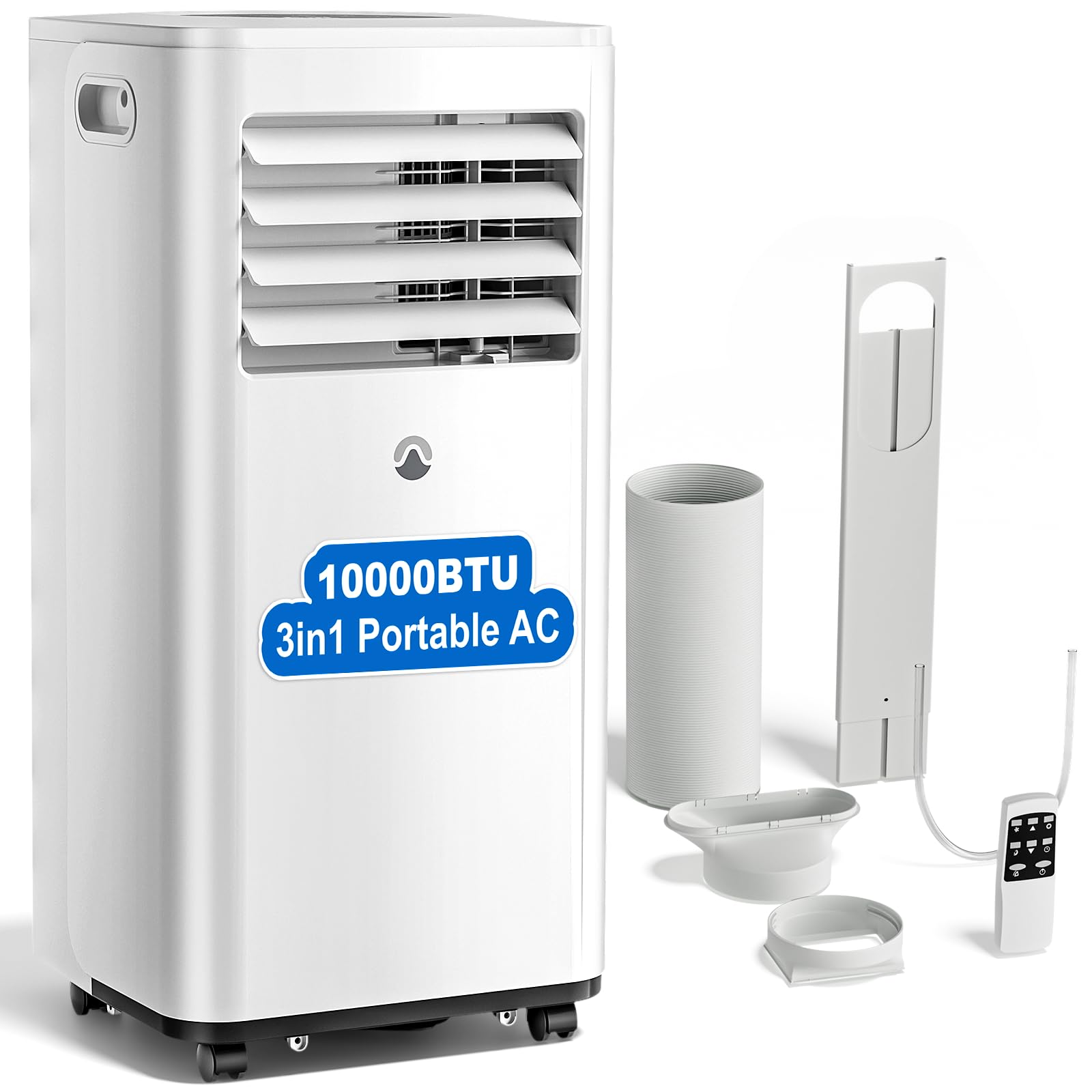
A 10,000 BTU unit that cools, fans, and dehumidifies rooms up to 450 sq. ft. without permanent installation.
Pros:
- 3-in-1 modes (AC, fan, dehumidifier) with adjustable temps from 60°F–86°F
- Sleep mode operates under 50 dB with a 24H programmable timer for hands-off overnight cooling
- 360° caster wheels and included window kit (fits 36.61–49.6" openings) allow tool-free setup and easy room-to-room moves
Cons:
- CEER 7.0 efficiency rating trails comparably priced window units
- Single-hose design can pull warm air from adjacent rooms, reducing overall cooling effectiveness
Best For: Renters or apartment dwellers who need flexible, no-install cooling for a bedroom or home office under 450 sq. ft.
DREO 318S Portable Air Conditioner
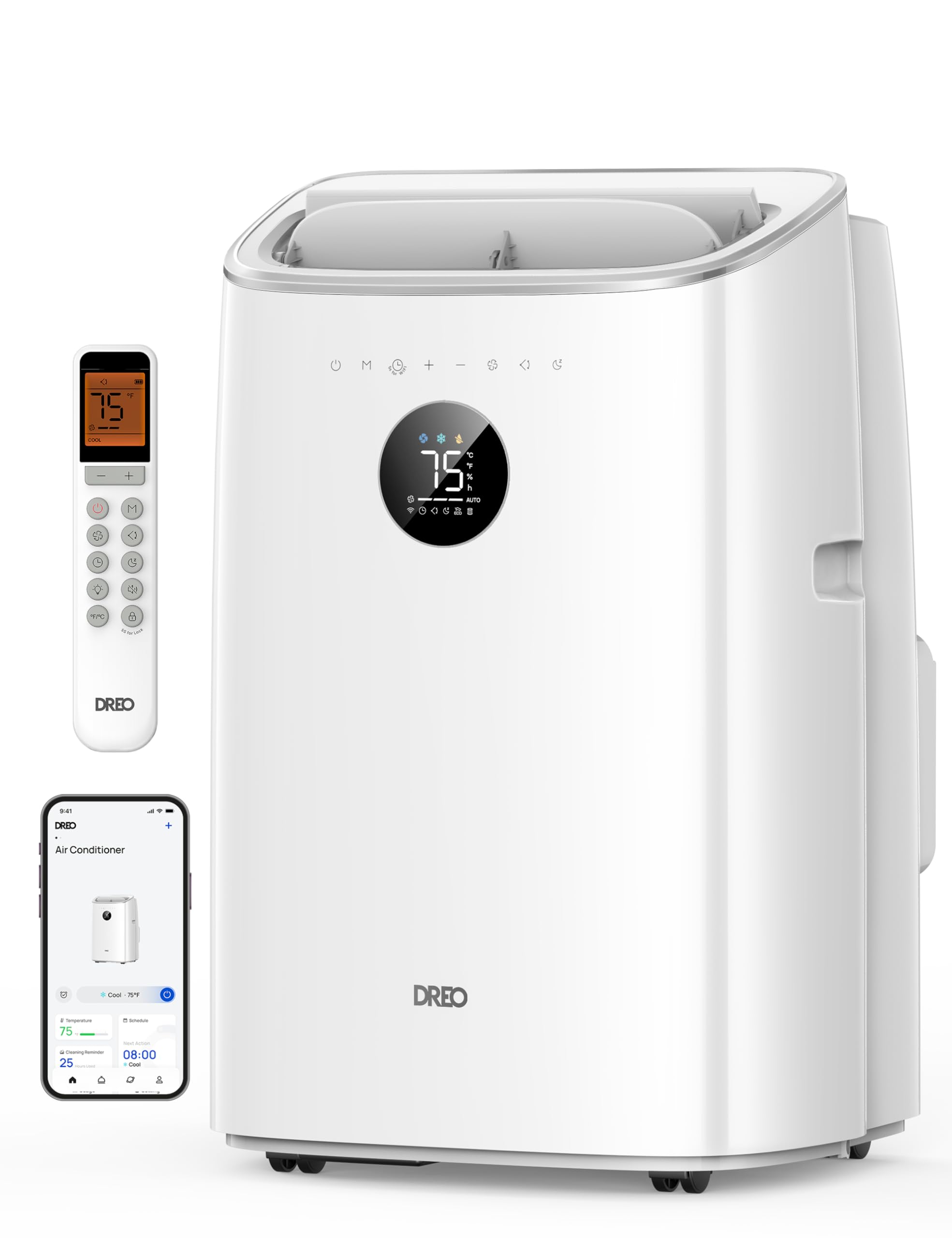
A portable 3-in-1 unit (AC, fan, dehumidifier) built for bedrooms and small rooms, with full smart home integration.
Pros:
- Drainage-free operation up to 90% humidity eliminates manual tank emptying
- 45dB noise floor makes it viable for sleep or focused work without disruption
- Compatible with Alexa, Google Home, and Siri, plus app and remote control
Cons:
- True cooling capacity is 5,000 BTU DOE (SACC), limiting effective coverage to roughly 300 sq ft
- At $389.99, it's priced high for a single-hose portable
Best For: Renters in small bedrooms (up to ~300 sq ft) who prioritize quiet, hands-free climate control over raw cooling power.
Portable Air Conditioner 14000 BTU
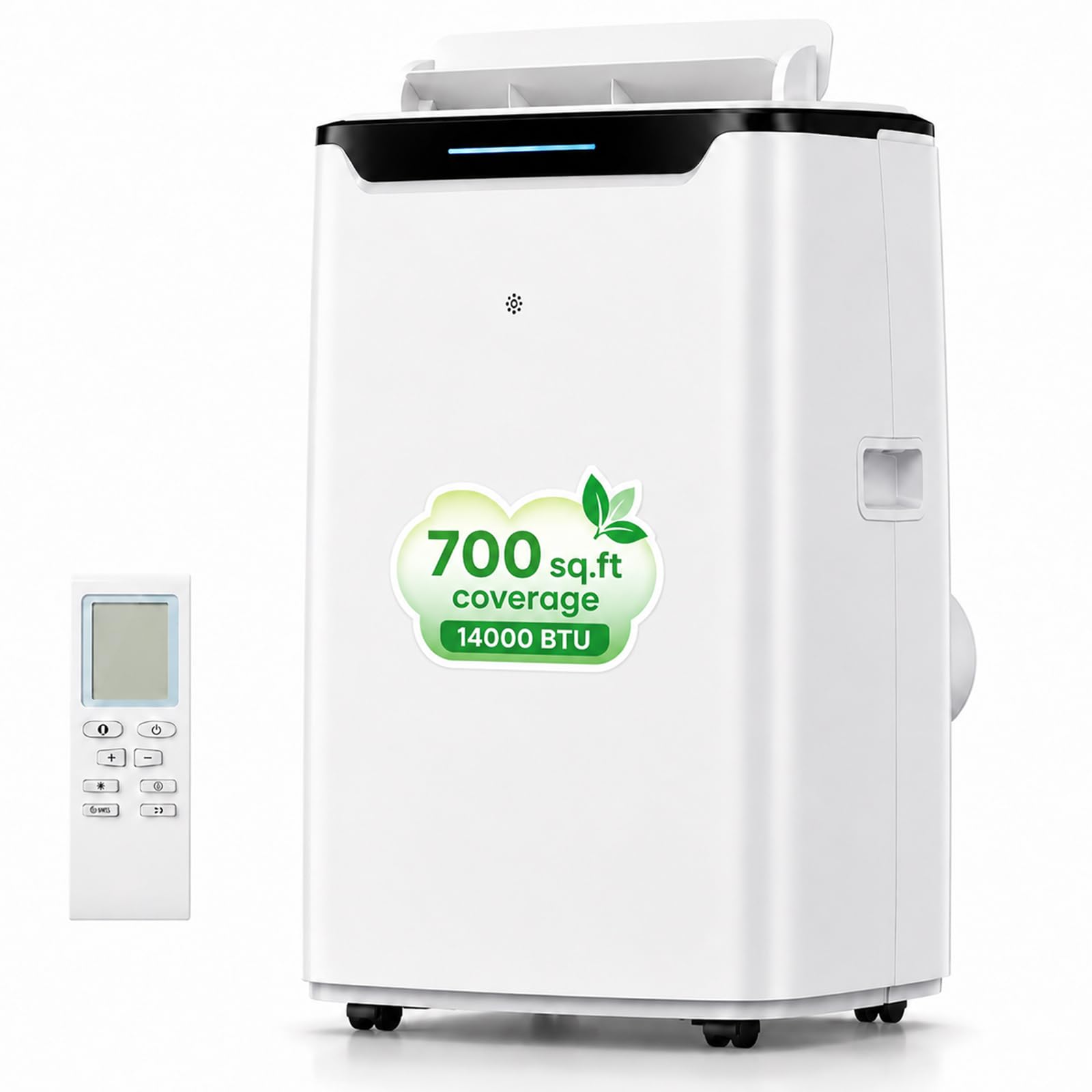
A 3-in-1 portable unit (cool, fan, dehumidify) built for large spaces up to 700 sq. ft., using an upward full-width vent for faster whole-room air circulation.
Pros:
- 14,000 BTU with 235 CFM airflow covers up to 700 sq. ft. — larger than most competitors in this price range
- CEER 7.8 efficiency rating helps manage electricity costs during long summer stretches
- Sleep Mode drops noise to 50dB; remote control reaches up to 26 ft. away
Cons:
- 50dB is still audible — not ideal for the lightest sleepers
- Single-hose design is inherently less efficient than dual-hose models in extreme heat
Best For: Renters and apartment dwellers who need powerful, no-drill cooling for large living rooms or upstairs bedrooms.
16000 BTU WiFi Portable Air Conditioner
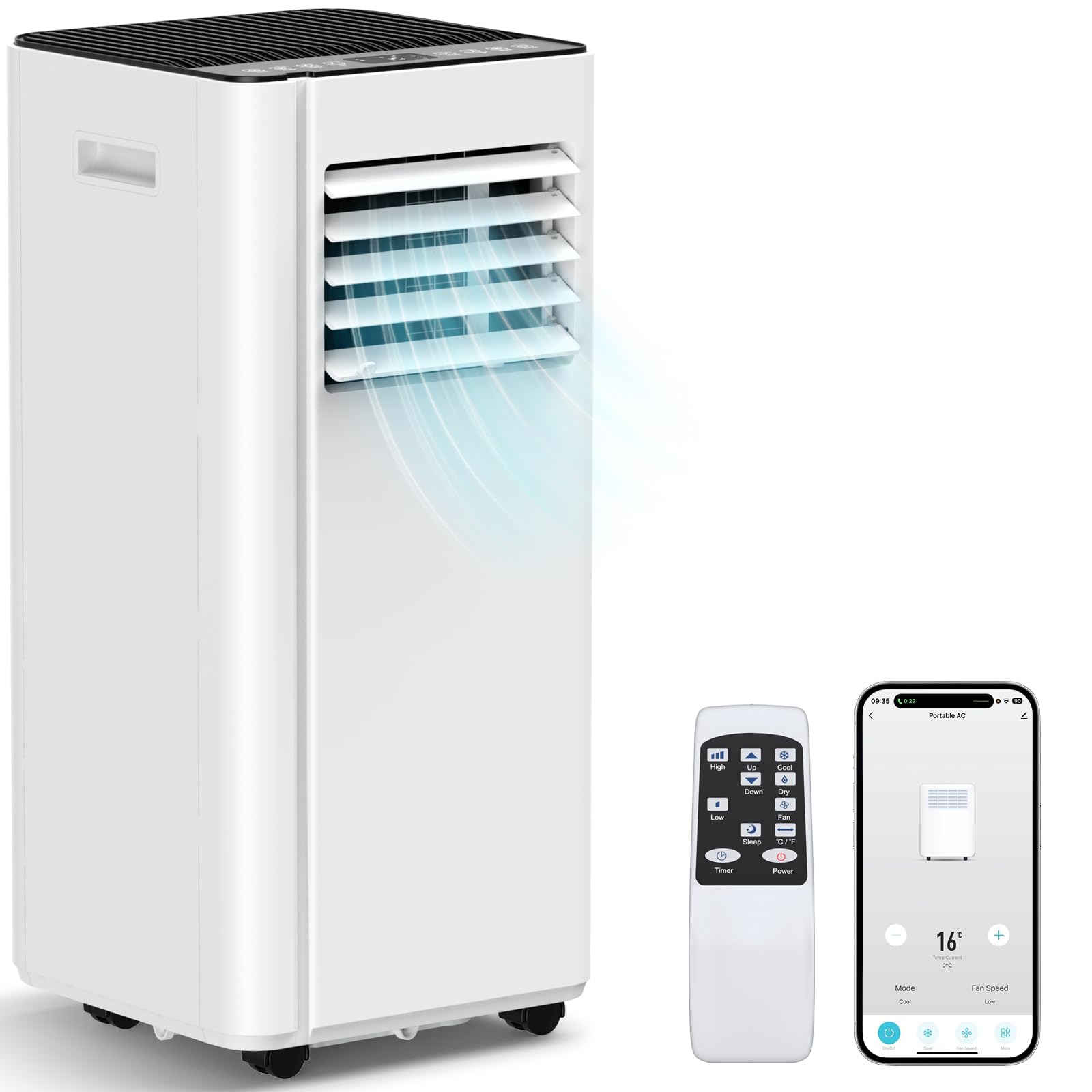
A self-evaporating portable cooler for large rooms up to 750 sq. ft. with WiFi app control and five operating modes.
Pros:
- 16,000 BTU cools up to 750 sq. ft. — larger coverage than most portable units
- Operates at 40dB in Sleep Mode with a 24-hour programmable timer
- Self-evaporating system means no manual tank emptying in cooling mode
Cons:
- $359.98 is on the premium end for a portable AC
- Single-hose design reduces efficiency compared to window units
Best For: Renters needing flexible, powerful cooling for large open spaces without permanent installation.
Midea 5,000 BTU EasyCool Window Air Conditioner

A compact 5,000 BTU window unit built to cool rooms up to 150 sq. ft. with simple mechanical controls.
Pros:
- CEER rating of 11.0 helps keep energy bills low during extended use
- Operates quieter than a household refrigerator, with 2 cooling speeds and 2-way air direction
- Fits windows 23"–36" wide; all mounting hardware included
Cons:
- Coverage capped at 150 sq. ft. — not suitable for medium or larger rooms
- No remote or digital display; mechanical dials only
Best For: Budget-conscious renters needing reliable, no-frills cooling for a small bedroom or home office.
Frigidaire 3-in-1 Portable Air Conditioner 10,000 BTU

A single-hose portable unit that cools, fans, and dehumidifies spaces up to 450 sq. ft. without permanent installation.
Pros:
- 3-in-1 modes (AC, fan, dehumidifier) with three fan speeds and auto-swing louver for targeted airflow
- 24-hour programmable timer and Auto Restart restore previous settings after power outages
- Sleep Mode gradually adjusts temperature overnight for quieter, energy-saving operation
Cons:
- True DOE rating is 6,500 BTU—well below the marketed 10,000 BTU (ASHRAE), so real-world cooling falls short near the 450 sq. ft. limit
- Single-hose design draws indoor air for exhaust, slightly reducing overall efficiency
Best For: Renters wanting flexible, room-to-room cooling in apartments or bedrooms under 350 sq. ft.
Hykolity 10,000 BTU WiFi Portable Air Conditioner
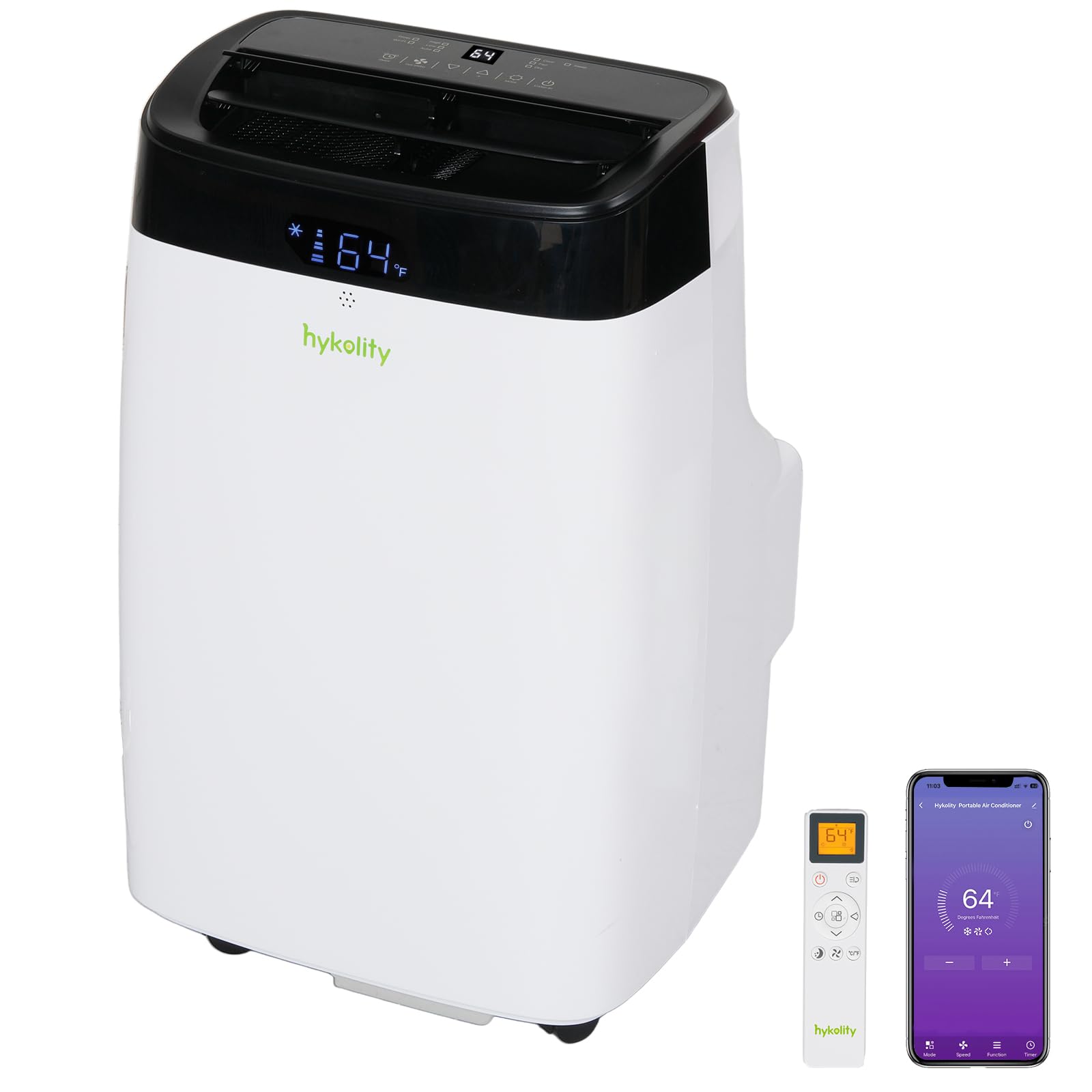
A WiFi-enabled portable AC with five operating modes for flexible single-room cooling.
Pros:
- Dual-motor technology runs at 45 dB — quiet enough for bedrooms and offices
- Smart Life app and included remote enable full control from anywhere
- Self-evaporating design reduces the need for manual drainage
Cons:
- 10,000 BTU is ASHRAE-rated; the DOE equivalent is 6,000 BTU, meaning realistic coverage is closer to 250–300 sq ft, not the advertised 450
- Single-hose design draws warm air in from adjacent spaces, limiting efficiency
Best For: Renters wanting app-controlled, no-install cooling for a small bedroom or home office.
What to Look for in a Portable Air Conditioner for Small Rooms
Buying a portable AC is surprisingly easy to get wrong. Manufacturers lean on inflated specs and vague marketing language, which means a unit that looks powerful on the box can leave you sweating in a warm room. Here's how to cut through the noise and pick the right unit.
Start With SACC BTU — Ignore the Big Number on the Box
Every portable AC box features a large BTU number prominently on the front — but that figure (the ASHRAE rating) is measured under ideal lab conditions that don't reflect how the unit actually performs in your home. The number you want is the SACC (Seasonal Energy Efficiency) DOE rating, sometimes labeled "DOE BTU." It accounts for heat leakage through the exhaust hose and gives you a realistic picture of cooling output.
As a practical rule of thumb:
- 150–250 sq ft: Look for 6,000–8,000 BTU SACC
- 250–350 sq ft: Look for 8,000–10,000 BTU SACC
If your room gets heavy afternoon sun, has poor insulation, or sits on an upper floor, size up one tier — heat load matters more than square footage alone.
Single-Hose vs. Dual-Hose: Efficiency Isn't Free
Single-hose units are the most common and affordable option, but they have a hidden inefficiency: they exhaust indoor air outside, creating negative pressure that pulls warm, humid air in through gaps around doors and windows. For most small rooms (under 250 sq ft) this is manageable, but it does reduce effective cooling.
Dual-hose units draw outside air for condenser cooling and exhaust it back out through a second hose, so they don't depressurize your room. They're more efficient, cool faster, and work better in rooms that aren't well-sealed — worth the extra cost if you're cooling a 300+ sq ft space or a room with lots of air leakage.
EER2 Rating: Your Long-Term Energy Cost
The EER2 (Energy Efficiency Ratio) tells you how much cooling you get per watt of electricity consumed — the higher the number, the less it costs to run. This matters because portable ACs run for hours at a time during heat waves, and a low-efficiency unit can meaningfully spike your electric bill over a summer.
Look for an EER2 of 8.5 or higher for a solid efficiency baseline. Units with ENERGY STAR certification have been independently verified to meet minimum efficiency standards and are a reliable shortcut if you don't want to compare raw specs.
Noise Level: Decibels Matter More Than You Think
Portable ACs are not quiet appliances, but the range varies significantly — from around 50 dB to 60+ dB on low fan settings. For a bedroom or home office, that difference is the gap between a unit you forget is running and one that disrupts sleep or video calls.
Look for noise ratings in the 52–56 dB range for bedroom use. If the manufacturer doesn't publish a decibel rating, that's a yellow flag — brands confident in their noise performance tend to advertise it.
Drainage Setup: Auto-Evaporation vs. Manual Bucket
All portable ACs collect condensate (moisture pulled from the air), and how they handle it affects how much maintenance you'll do. Fully auto-evaporative units exhaust most or all moisture through the vent hose — you rarely need to empty anything. Gravity-drain or manual-bucket units require you to empty a tank every 8–12 hours in humid conditions, which becomes a chore fast.
For humid climates or climates with muggy summer nights, auto-evaporation is worth prioritizing. If your climate is dry, drainage method matters less.
Installation Kit and Window Compatibility
Every portable AC includes a window exhaust kit, but fit is not universal. Most kits are designed for standard double-hung windows and work fine. Sliding windows, casement windows, or oddly-sized openings often require aftermarket adapters or creative DIY solutions.
Before buying, confirm the kit spans your window's height or width range, and check whether the exhaust hose diameter (typically 5" or 6") matches any adapter you may already own. A unit with a well-engineered, airtight window kit also reduces heat infiltration — a detail that directly affects real-world performance.
Price vs. Performance: Where the Value Actually Lives
The portable AC market clusters into three bands:
- $200–$350: Budget single-hose units. Adequate for very small rooms (under 200 sq ft) in mild climates, but often sacrifice EER2 and noise performance.
- $350–$550: The sweet spot for most buyers. You'll find well-reviewed single-hose and entry dual-hose units with reasonable EER2 ratings and auto-evaporation.
- $550+: Premium dual-hose units, smart-home integration, and near-silent operation. Worthwhile for frequent or all-day use, less so for occasional cooling.
Spending more than you need on BTUs (chasing that large ASHRAE number) rarely buys you comfort — spending more on efficiency and noise usually does.
🚀 Get FREE 2-Day Shipping with Amazon Prime
Try Amazon Prime FREE for 30 days! Enjoy fast, free delivery on millions of items, plus exclusive access to movies, TV shows, music, and more.
Start Your Free Trial →No commitment. Cancel anytime during the trial.
The BTU Lie Nobody Warns You About
That "12,000 BTU" portable AC on the store shelf is almost certainly not delivering 12,000 BTU of actual cooling — and the manufacturer isn't technically lying. The number comes from an outdated lab test that doesn't reflect how the unit performs in your home. Understanding the difference between ASHRAE and SACC ratings is the single most important thing you can do before buying a portable air conditioner.
ASHRAE BTU vs. SACC (DOE) Rating — What the Numbers Really Mean
The ASHRAE rating measures cooling output under perfect laboratory conditions — no leaks, no heat gain, no real-world friction. The DOE's newer SACC (Seasonally Adjusted Cooling Capacity) standard is far more honest: it factors in the heat the unit's compressor and motor radiate back into your room, plus air infiltration through the exhaust hose connection. The result is a sobering gap — a unit marketed as "12,000 BTU ASHRAE" typically delivers only 8,000–9,000 BTU SACC in practice. SACC is the number that actually predicts whether your room will get cool.
How to Match Real Cooling Capacity to Your Room Size
Always shop by SACC, never ASHRAE — it's the only apples-to-apples comparison across brands. Use this chart as your starting point:
- 150–250 sq ft → 6,000–8,000 BTU SACC
- 250–350 sq ft → 8,000–10,000 BTU SACC
- 350–450 sq ft → 10,000–12,000 BTU SACC
If your space has poor insulation, south-facing windows, or is a sunroom or bonus room, size up one full tier. A room that "should" need 8,000 BTU SACC will likely need 10,000 BTU SACC once real-world heat load is factored in.
Single Hose vs. Dual Hose: The Efficiency Gap That Costs You Money
Most buyers choose portable AC units based on BTU rating alone — but the hose configuration may have a bigger impact on your electricity bill and comfort level than raw cooling power ever will.
How Single-Hose Units Create Negative Air Pressure (and Why That's Bad)
A single-hose unit exhausts hot air outside, but that expelled air has to be replaced — and it gets pulled in through every gap, crack, and door seal in the room. This creates a subtle negative pressure loop that continuously floods your space with warm, humid, unconditioned air, forcing the compressor to work harder just to maintain temperature. In a leaky room, you're essentially fighting your own AC unit.
When a Dual-Hose Unit Is Worth the Extra $50–$150
Dual-hose units use a dedicated intake hose to draw outside air for condenser cooling, keeping the room's air pressure balanced and eliminating that energy-wasting infiltration cycle. The result is measurably faster cool-down times and more stable temperature maintenance — especially noticeable in larger or poorly sealed spaces. Invest in dual-hose if any of these apply to you:
- Room size over 250 sq ft — negative pressure effects scale with volume
- Poorly insulated spaces — sunrooms, converted garages, or older construction
- All-day runtime — the efficiency savings compound over long operating hours
For a well-sealed studio under 200 sq ft used intermittently, a quality single-hose mid-range unit performs adequately and saves money upfront.
Noise, Efficiency, and the Features That Actually Matter
Understanding Decibel Ratings in Context
Most portable ACs operate between 52–58 dB — roughly the volume of a normal conversation or a running dishwasher. Units marketed as "quiet" at 54 dB or higher are technically misleading; genuine quiet starts below 52 dB. Sleep mode is a meaningful differentiator: it reduces fan speed and gradually raises the set temperature to minimize compressor cycling throughout the night. Premium units with inverter compressors take this further, eliminating jarring on/off cycling entirely — a noticeable upgrade if you're a light sleeper.
CEER Ratings and What They Mean for Your Electric Bill
CEER (Combined Energy Efficiency Ratio) is the single most important spec most buyers overlook. Budget units score 8–9, mid-range models land at 10–11, and premium units reach 12 or higher. The difference adds up fast: running a CEER 9 unit versus a CEER 11 unit for 8 hours a day over a 90-day season can cost $40–$80 more in electricity. Over a unit's 5–7 year lifespan, that gap easily exceeds the price difference between tiers — making efficiency a smarter long-term investment than chasing a lower sticker price.
Self-Evaporation: The Feature Renters Wish They'd Prioritized
Non-self-evaporating units collect condensate in an internal tank that must be manually drained every 8–24 hours in humid climates — a chore that catches first-time buyers completely off guard. Run one overnight without draining, and many units auto-shut off mid-cycle, leaving you to wake up in a warm room. Here's what to look for:
- Full self-evaporation — vents moisture automatically through the exhaust hose; zero maintenance required
- Partial self-evaporation — significantly reduces draining frequency but doesn't eliminate it entirely
- No self-evaporation — avoid if you live in a humid region or plan to run the unit overnight
Smart Features Worth Paying For (and Those That Aren't)
Wi-Fi connectivity has real, practical utility: pre-cooling a room before you arrive and scheduling around your routine can meaningfully cut runtime and lower your energy bill. It's a worthwhile addition at the $450+ price range where it's increasingly standard; below that, don't let it drive your buying decision. One genuinely overlooked dealbreaker: always verify your window type before purchasing. Standard kits fit double-hung windows 26–48 inches wide, but casement, awning, or jalousie windows require a third-party universal kit — adding $30–$60 to your budget before day one.
Who Should Buy a Portable AC (And Who Should Consider Alternatives)
Portable ACs fill a genuine gap in the cooling market, but they're the right tool for specific situations — not a universal upgrade. Understanding where they shine (and where they fall short) will save you money and frustration before you buy.
Renters, Casement Windows, and Portability Between Apartments
Portable ACs are the strongest fit when a window unit simply isn't an option. Many landlords prohibit window installations outright, and casement or jalousie windows don't accommodate standard window unit brackets regardless of lease terms. Portability is a real advantage for renters who move frequently — one unit travels with you rather than being left behind or reinstalled. Ideal buyers include:
- Renters in buildings with no-modification clauses
- Homeowners with casement, sliding, or non-standard windows
- Seasonal users who need a unit that stores compactly (most models fit in a standard closet)
- Multi-room coolers who need flexibility to move the unit between a bedroom at night and a home office by day
Remote Workers: Why Quiet Matters More Than BTUs
If you're logging 8+ hours daily in a room your central system can't adequately cool, don't optimize for price — optimize for noise. A unit running at 56 dB will create measurable cognitive fatigue over a full workday and bleed into video calls; models with inverter compressors typically operate at 50–53 dB and modulate output rather than cycling on and off, which eliminates the jarring compressor-kick noise. The ROI on a quieter, more efficient inverter model pays off quickly in sustained focus and productivity — often within a single summer.
When a Window Unit or Mini-Split Is the Smarter Choice
Be honest with yourself here: portable ACs are inherently less efficient than alternatives due to in-room heat exchange and, in single-hose designs, the negative pressure problem that draws warm air in from adjacent spaces. If you're switching from a window unit, expect roughly 20–30% higher electricity costs for equivalent cooling output. A window unit delivers significantly better performance per dollar if installation is feasible. Mini-splits are superior across every performance metric — quieter, more efficient, and capable of heating — but professional installation runs $1,000–$3,000+ and requires permanent wall mounting, making them impractical for renters or those with short-term cooling needs.
Frequently Asked Questions
What BTU portable AC do I need for a 300 sq ft room?
For a 300 sq ft room, aim for a portable AC rated at 8,000–10,000 BTU SACC (the DOE standard rating) — just make sure you're shopping by SACC, not the inflated ASHRAE number on the box, since a "12,000 BTU ASHRAE" unit may only deliver around 8,000 BTU SACC in real-world cooling. If your room has large south-facing windows, poor insulation, or sits on an upper floor, size up to 10,000–12,000 BTU SACC to handle the extra heat gain. When in doubt, go slightly larger — an oversized unit reaches your target temp quickly, while an undersized one runs nonstop and never quite gets there.
Final Verdict
The BLACK+DECKER BPACT08WT is our top pick for small-room cooling — its 8,000 BTU output (3,950 BTU SACC) reliably handles spaces up to 400 sq. ft., and the Follow Me remote with included window kit makes setup and daily use refreshingly simple. It strikes the right balance of performance, convenience, and price that most renters and remote workers actually need.
Before you buy, measure your room and always check the SACC rating — not the ASHRAE number. Ready to decide? Browse our comparison table above and drop your questions in the comments — we're happy to help you find the right fit!